De mieren (Formicidae) van Vlaanderen.
 Inleiding


Formicidae : Myrmicinae : Myrmica : Myrmica hirsuta
Myrmica hirsuta Elmes, 1978
Datum van de beschrijving: 1978
Beschreven door: Elmes, pagina(s) 131.
Referentie van de originele beschrijving:
-
Elmes, G.W., 1978. A morphometric comparision of three closely related species of Myrmica (Formicidae), including a new species from England. Systematic Entomology 3: 131-145.
Synoniemen:
Nederlandse naam: ruige gaststeekmier
* * * * *
typebeschrijving
(ii) Holotype: author's reference number D1 -B total length 5.50 mm. A female without wings.
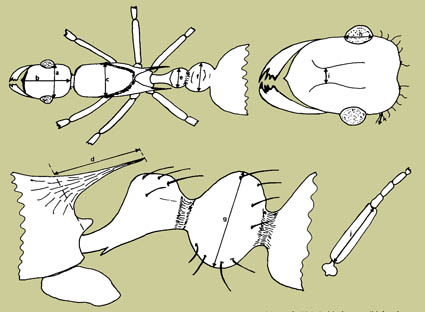
Head: light, ginger brown, moderately sculptured and covered with erect bristles that are conspicuous at the rear side of the head. The mandibles are normal for Myrmica, having a large apical tooth and others reducing in size. The eyes appear to be large but in fact tend to be isometric with headwidth compared with Myrmica sabuleti. The antennae have twelve segments and a distinct bend of the scape near to the base that is typical for the Myrmica scabrinodis group; there are lateral projections at the bend but these are reduced and could be confused with the scape of M. scabrinodis. (Headwidth 1.02 mm, head length 1.12 mm, frons width 0.40 mm, eye length 0.28 mm, length of a typical bristle 0.15 mm; see Fig. 1 for details of measurement.)
Thorax: the thorax is moderately sculptured and slightly darker than the head, the parapsidal furrows are distinct. The spines are relatively short and blunt, curved inwards. Bristles are obvious,especially on the pronotum and scutellum. The legs are normal for the genus Myrmica, having large pectinate spurs on the tibia of the first pair and reduced pectinate spurs on the remaining pairs. (Thorax width 0.96 mm; thorax length 1.70 mm, spine length 0.32 mm; see Fig. 1.)
Abdomen: the gaster is lighter in colour than the head. The petiole is wide and the post-petiole is very wide. Bristles are obvious especially on the petiole region (Fig. 2). The post-petiole is wider than it is a tendency for the surface of the petiole node (seen in lateral profile) to slope backwards when compared with that of a Myrmica sabuleti queen (Fig. 2). A sting is present. (Post-petiole width 0.62 mm, post-petiole height 0.53 mm, post-petiole length 0.44 mm, petiole width 0.38 mm, petiole length 0.50 mm; see Fig. 1.)(iii) Paratype: a winged male; author's reference number D1-10, total length 5.30 mm.
Head: is shiny black, finely punctuated with erect hairs that are easily visible at the back of the head. The clypeus is smooth and shiny and the mandibles have a large apical tooth and several equally small teeth. The eyes are isometric with head width but appear to be large and protruding. The antennae has thirteen segments, the scape is short with a bend near to the base. (Headwidth 0.82 mm, head length 0.90 mm, frons width 0.24 mm, eye length 0.28 mm, scape length 0.50 mm, length of a typical bristle 0.14 mm; see Fig. 1 for measurement.)
Thorax: is the same colour as the head having fine striations. The wings are as Myrmica with a closed discoidal and partially dissected cubital cell. The legs are yellowish brown with large pectinate spurs on the tibia of the first pair and reduced pectinate spurs on the other two pairs. The spines are rudimentary and have some bristles. (Thorax width 0.8 mm, thorax length 1.80 mm; see Fig. 1.)
Abdomen: is black and shiny with obvious long hairs. These are particularly visible on the petiole and post-petiole. The post-petiole is wide compared to headwidth and is wider than it is high, contrasted with M.sabuleti where the post-petiole is higher than it is wide. (Post-petiole width 0.56 mm, post-petiole height 0.56 mm, post-petiole length 0.46 mm, petiole width 0.42 mm, petiole length 0.44 mm; see Fig. 1.)
* * * * *