De mieren (Formicidae) van Vlaanderen.
 Inleiding


Formicidae : Myrmicinae : Myrmica : Myrmica schenckioides
Myrmica schenckioides Boer & Noordijk, 2005
Datum van de beschrijving: 2005
Beschreven door: Boer & Noordijk, pagina(s) 120-123.
Referentie van de originele beschrijving:
-
Boer, P. & Noordijk, J., 2005. Myrmica schenckioides nov.sp., a new socially parasitic ant species (Hymenoptera, Formicidae). Ent. Berichten 65(4), 2005.
Synoniemen:
Volgens Seifert (en anderen - zie hieronder) zou het hier gaan om een morfologische afwijking van Myrmica schencki. (Seifert, B., 2007, p. 142)
Nederlandse naam: kokergaststeekmier
* * * * *
typebeschrijving
Myrmica schenckioides nova species
Description
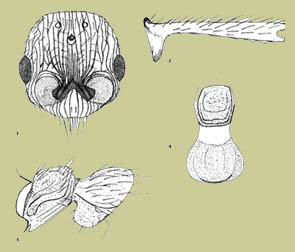
Several characteristics of the head distinguish the gyne from other Myrmica species. The frons of M. schenckioides is narrow (figure 1). The anterior clypeal margin is broadly convex and the medial margin is a little emarginated. The antennal scape is relatively short, with a broad and high flange at the dorsoproximal bend site (figure 2) and does not reach the occipital margin. The propodeal spines are short (figure 3). The postpetiolar node is wide and high (figure 4), with a rounded ventral process (figure 3).
The middle and hind tibiae spurs are comparable to other Myrmica species, but they are slender and have relative short dentation.
The sculpture of the entire body is quite coarse. The frons has longitudinal rugae on occiput, and sides with sparse reticulation. The clypeus has longitudinal rugae as well (figure 1). The sides and dorsum of the alitrunk have longitudinal rugae. The petiolar node has lateral rugae, without reticulation and with an anteroventral to caudodorsal orientation (figure 3). The petiolar and postpetiolar nodes are dorsally more or less smooth (figure 4). The head and alitrunk have relative short, straight standing hairs (figure 1). The antennal scape has subdecumbent hairs, which are shorter than the scape width (figure 2). There is no pubescence on the gaster.
Head, dorsal half of the alitrunk and gaster are dark brown. The appendages, nodes and ventral half of the alitrunk are yellowish brown. The antennal scape is even paler. All hairs are thinner than in M. schencki and white.
In table 1, several measurements and indices of M. schenckioides are compared with the most resembling species: M. schencki Viereck, M. myrmicoxena Forel, M. lemasnei Bernard and M. karavajevi (Arnoldi).
Holotype: female. Type locality: Beekhuizerzand, Harderwijk, Gelderland, The Netherlands, 52°20’N 5°40’E. Out of a pitfall, 12.v.2004 - 14.x.2004. The holotype is deposited in the collection of the National Museum of Natural HistoryNaturalis in Leiden.
* * * * *
In 2004 werd in Nederland een "nieuwe parasitaire steekmier" ondekt in een heischraal grasland. De karakteristieke eigenschappen van de gevonden gyne deden vermoeden dat de gastheer van deze nieuwe soort Myrmica schencki is. De kokergaststeekmier of Myrmica schenckioides heeft volgens de auteurs meerdere kenmerken om ze als een nieuwe soort te erkennen en niet louter als een 'afwijking' van M. schencki. De meest opvallende kenmerken zijn de brede lob aan de onderzijde van de postpetiolus, de smalle frons, de witte beharing en de scapus.
* * * * *
Dit holotype is blijkbaar geen lang leven beschoren en zal de geschiedenis ingaan als een teratologisch exemplaar van een bestaande soort.
> Czechowski, Radchenko en Czechowska (2007) plaatsen bij deze soortbeschrijving volgende opmerking :
"Recently a solitary gyne found in the field prompted the description of Myrmica schenckioides, regarded as a social parasite (Boer and Noordijk 2005). The authors do admit that they considered the possibility of the specimen being a parasitised, for example, mermithised, gyne of M. schencki, but nevertheless regarded observed differences as sufficient to warrant the description of a new species. While we do not wish to declare their decision as right or wrong, we feel that researchers must be warned not to rashly propose new ant species, especially among the well-studied European fauna, on the basis of solitary individuals of unknown origin in a rush, also given the fact that such profound and complex structural modifications of the host can be caused not only by mermithid infestation, as described in this paper, but also by many other internal parasites of ants (see e.g. Passera 1975, Espadaler and Riasol 1983)."
> In hun publicatie over het genus Myrmica nemen Radchenko & Elmes (2010) M. schenckioides niet op als een afzonderlijk taxon maar geven hierover hun visie weer bij de beschrijving van M. schencki (p. 270):
"Boer et Noordijk (2005) described from The Netherlands M. schenckioides based on a single unusual winged gyne, found in a pitfall trap. By the size and by the shape of its head, frons and scape it corresponds to normal gynes of M. schencki, but differs by having very short, though sharp, propodeal spines, a "male-shaped" petiole and a short and high postpetiole with a quite well developed ventral lobe (or rather just enlarged postpetiolar sternum). Based on these differences, Boer et Noordijk assumed that it is a social parasite of M. schencki which also lives in the type locality. Nevertheless, despite a very intensive investigation of the biology of M. schencki, especially during last two decade when many thousands of the nests have been dug-out throughout Europe (see ecology below), no one has ever reported finding a socially-parasitic Myrmica species in a M. schencki nests. In our opinion, this specimen M. schenckioides is an aberrant specimen of M. schencki produced either by some genetic malformation or by infestation by a Mermis parasite (e.g. see Czechowski, Radchenko and Czechowska 2007). We therefore synonymise it with M. schencki."
> Csösz (2012) neemt Myrmica schenckioides op in zijn bespreking van de invloed van door nematoden besmette specimen bij de beschrijving van nieuwe soorten. Hij wijst erop dat verschillende oorzaken gekend zijn die het fenotype van een soort kunnen wijzigen waardoor de juistheid van taxa die ooit maar één keer werden gevonden, in vraag wordt gesteld. Door middel van X-stralen microtomografie (XMT) heeft hij in het abdomen van type-exemplaren de aanwezigheid van nematoden aangetoond die een afwijkende morfologie veroorzaakten. Hierdoor heeft hij Myrmica symbiotica (Menozzi, 1925) als nieuw junior synoniem van Myrmica scabrinodis Nylander, 1846 geplaatst en wordt Myrmica myrmecophila Wasmann, 1910 als junior synoniem van Myrmica sulcinodis Nylander, 1846 (van Boven 1970) bevestigd. Wat Myrmica schenckioides betreft, wordt het junior synoniem van Myrmica schencki Viereck, 1903 (Radchenko & Elmes, 2010) eveneens bevestigd ondanks het feit dat in het gaster geen nematoden werden aangetoond. Door het ontbreken van duidelijke resten van ovaria en de afwijkende vorm van petiolus en postpetiolus gaat de auteur ervan uit dat het hier niet gaat om een nieuwe soort maar om een geval van teratologie.
* * * * *